Mouse control in Den Bosch: the signs to look for
House mice are mostly active at night and leave small traces wherever they go. If you know what to look for, you can often spot a problem at an early stage.
- dark droppings the size of a grain of rice in cupboards, drawers and along skirting boards
- gnaw marks on packaging, cables or the corner of a door
- scratching and scurrying in ceilings, walls or the meter cupboard
- a sharp, musty smell of urine in closed-off spaces
- nests made of paper, fabric or insulation
A mouse running about in daylight usually means there are more. Mice breed quickly, so waiting only makes the job bigger.
How mice get into your home
A mouse needs very little room: a gap of about 6 mm, roughly the thickness of a pencil, is enough. Typical entry points are pipe openings under the sink and in the meter cupboard, air bricks with slots that are too wide, gaps under outside doors and the wall cavity, which mice use to climb all the way up to the roof. In terraced houses and buildings that share walls, they simply carry on from one home to the next.
As soon as it turns colder, mice look for warmth and food indoors, and in October and November you tend to hear it in the walls and ceilings. Good pest control in Den Bosch therefore starts not with bait, but with finding the gaps they slip through.
Our approach, step by step
During the inspection we follow the trail: where are the droppings, which runs follow the walls, and where do they stop? That leads us to the entry point. We proof it with material mice cannot chew through, such as fine metal mesh, a metal grille or a brush strip under the door.
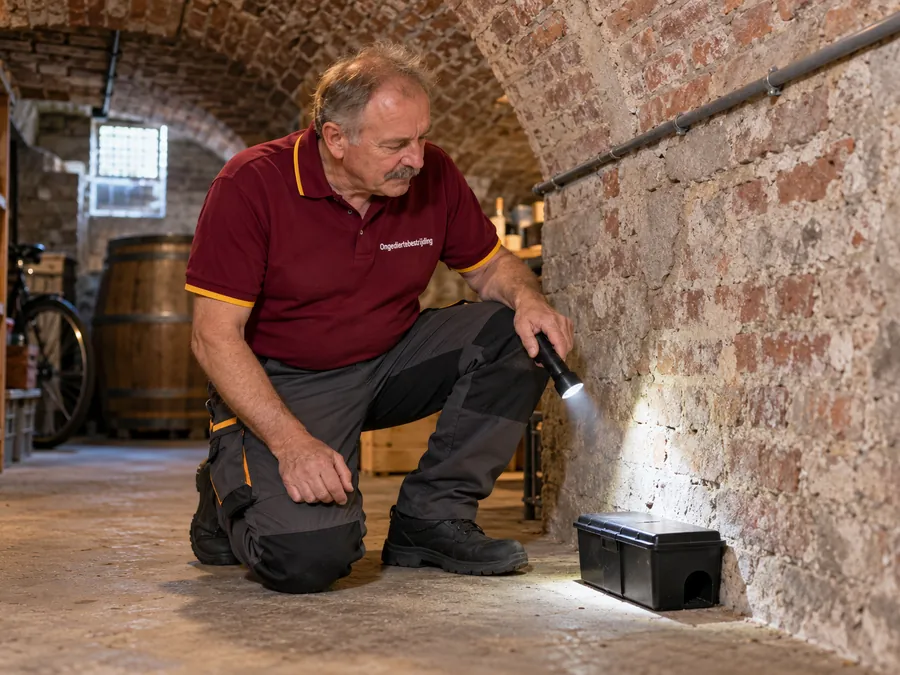
Then we deal with the mice still inside, using closed bait stations or snap traps along their runs, depending on the situation and on who lives in the house. Professional rodenticides may only be used by certified pest controllers – which is exactly what you call us for. On a follow-up visit we check for any remaining activity and collect everything again.
What to do yourself – and what to avoid
You can make life a lot harder for mice. Keep food in glass or hard plastic containers, don't leave cat biscuits or birdseed standing open, and clean behind the cooker and fridge regularly. Clear boxes and old newspapers out of the shed and cellar, as mice love to nest in them.
Avoid scattering loose poison from the supermarket or DIY store. Children and pets can get to it, and a mouse that dies inside a hollow wall will smell for days. Don't just block holes and leave it at that, either: any mice still inside must be caught at the same time, or they will gnaw a new way out, sometimes straight through your kitchen units.
Mouse or rat? The difference matters
Mouse droppings are small and thin; rat droppings are considerably bigger and thicker. Rats also tend to leave burrows in the garden and dark, greasy smear marks along walls. A rat usually comes in via the sewer or the garden, a mouse through a gap in the outside wall, and each calls for a different approach. Not sure which you have? Take a look at our page on rat control, or let us check on site.